Timelines of Blood Meridian
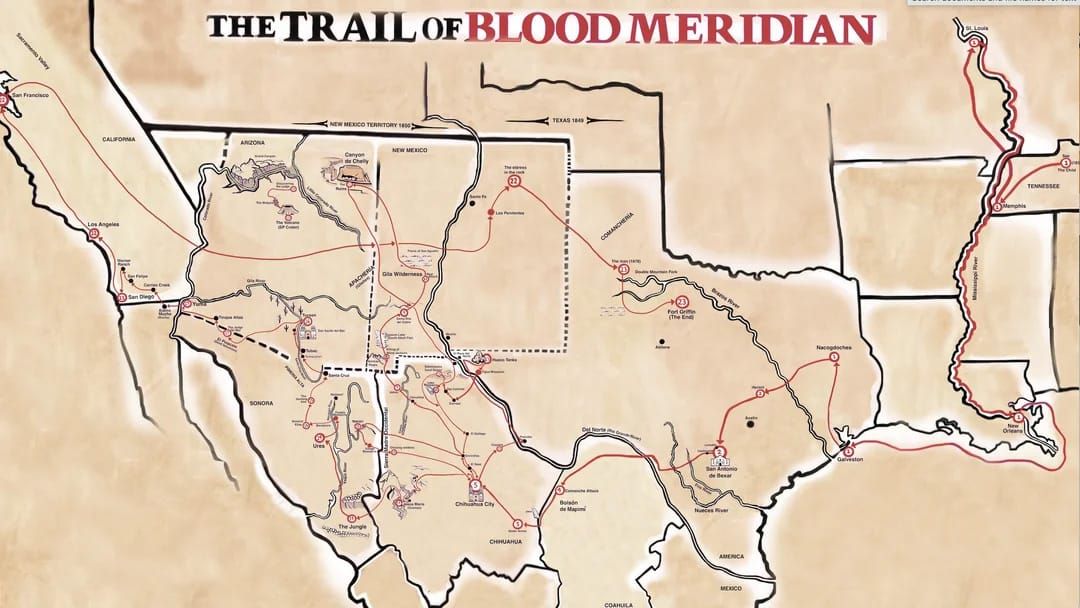
"The man who believes that the secrets of this world are forever hidden lives in mystery and fear. Superstition will drag him down. The rain will erode the deeds of his life. But that man who sets himself the task of singling out the thread of order from the tapestry will by the decision alone have taken charge of the world and it is only by such taking charge that he will effect a way to dictate the terms of his own fate."
– the judge, Blood Meridian
The first time I read Blood Meridian, I couldn't put it down. In hindsight, that first reading was a series of beautiful and/or terrifying moments, each unveiled and experienced discretely. I enjoyed the wild ride, but had no sense of how it all fit together.
The second time I read Blood Meridian, the individual events felt familiar but I realized that I didn't have a clear sense of how everything fit together. For example, I had forgotten that the vividly described attack of the Commanches – perhaps the most famous sentence in the entire book – happened to Captain White's outfit and not the Glanton gang.
I'm an inveterate note-taker (both of my parents are to blame), so I did what I always do when I find myself confused about a topic: I started taking notes. I've now read or listened to Blood Meridian many times, and those notes have grown with each re-reading.
I recently added to my notes some simple diagrams for different aspects of Blood Meridian's timeline that I wanted to keep clear in my mind, and those diagrams are the subject of this blog post. I've created them for my own future reference, but they may be useful or interesting to others who are re-reading Blood Meridian.
I suppose there is one other group of people who may find this post interesting: those who are certain they will never read this novel, which has been described by critics as "the most violent book ever written." I've included none of the violence below, so you can get a feel for the structure of the book without dealing with that aspect of it.
Reading vs re-reading
“We do not enjoy a story fully at the first reading. Not till the curiosity, the sheer narrative lust, has been given its sop and laid asleep, are we at leisure to savour the real beauties.”
― C. S. Lewis
There are books that are interesting or enjoyable to read once, and there are books that people tend to read over and over again. I've now read or listened to Blood Meridian perhaps a dozen times, and lately I've fallen into a bit of a rhythm where I revisit it in between the other books I've been reading. I saw literary critic Harold Bloom once mention in an interview that he couldn't finish Blood Meridian the first time he tried to read it, but eventually he read it dozens of times.
I enjoyed reading Agatha Christie's And Then There Were None twice last year, because it was fun to go back through the story knowing which character had been orchestrating the deaths of all the others. The first time through, it was a mystery, and the second time through it was the story of a series of clever deceptions. I enjoyed both reading experiences, although I feel like I'm done with the book after those two passes.
With Blood Meridian, on the other hand, I've found myself enjoying it even more after multiple readings. There is so much symbolism, so many literary references, and so many connections between different parts of the book, and as I get to know it better I find myself able to see more of the structure that wasn't visible to me in earlier readings.
For example, consider this passage from the scene where a traveling performer reads Tarot cards for the members of the Glanton gang:
When he came before the judge the judge, who sat with one hand splayed across the broad exanse of his stomach, raised a finger and pointed.
Young Blasarius yonder, he said.
Como?
El joven.
El joven, whispered the juggler. He looked about him slowly with an air of mystery until he found with his eyes the one so spoken. He moved past the adventurers quickening his step. He stood before the kid, he squatted with the cards and fanned them with a slow rhythmic motion akin to the movements of certain birds at court.
Una carta, una carta, he wheezed.
The kid looked at the man and he looked at the company about.
Si, si, said the juggler, offering the cards.
He took one. He'd not seen such cards before, yet the one he held seemed familiar to him. He turned it upside down and regarded it and he turned it back.
The juggler took the boy's hand in his own and turned the card so he could see. Then he took the card and held it up.
Cuatro de copas, he called out.
The woman raised her head. She looked like a blindfold manequin raised awake by a string.
Cuatro de copas, she said. She moved her shoulders. The wind went among her garments and her hair.
Within that brief passage, there are several allusions to other moments in Blood Meridian. Why does the judge refer to the kid as Blasarius, a term that appears nowhere else in the entire book? Why does that one card seem familiar to the kid? What is the significance of the way the woman is described in the final sentences? The answers to all of those questions only became visible to me after multiple readings, and I loved finding them.
Blood Meridian is a dense web of such connections, and I've had more of these "aha" moments in my most recent time through the book than I did in any of my first few readings. That's what makes it a fun book to re-read again and again. The thrill of discovering these connections between different parts of the book has replaced the thrill of reading McCarthy's descriptive prose for the first time, and since I know the individual scenes so well I'm now able to step back and "single out the thread of order from the tapestry," as the judge would say.
Three distinct periods
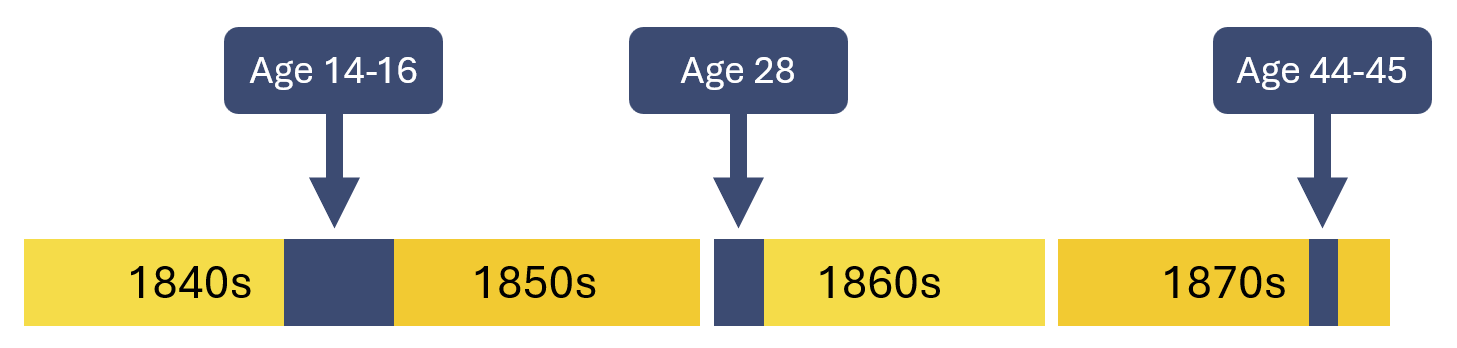
Blood Meridian's story spans several decades, but it doesn't describe every single year in that span of time. It tells the story of three distinct periods in the kid's life, as shown on the timeline below.
This disjointed structure seems to cause some confusion about the timeline. For example, this plot analysis (which has some otherwise great information in it), mentions that the 1878 meeting between the judge and the kid in Fort Griffin was "ten years after the Yuma attack," which had taken place in 1850.
Night of your birth. Thirty-three. The Leonids they were called. God how the stars did fall.
The book begins when the kid is 14 years old, and we quickly learn (from the ramblings of his drunk and loutish father) that he had been born on the night of Nvember 13, 1833 during the Leonid meteor shower. So the opening pages of the book are set in the winter of 1847/1848.
What follows is the story of the kid's journeys on both sides of the US/Mexico border, and this story is the bulk of the book. By word count, 95% of Blood Meridian takes place between the kid running away from Tennessee and his arrival in San Francisco a little over two years later.
In the spring of his twenty-eighth year he set out with others upon the desert to the east, he one of five at hire to see a party through the wilderness to their homes halfway across the continent.
The second section of the book is short – barely 700 words – but it plays an important role because it is when "the kid" becomes "the man."
While traveling alone in the desert, the kid encounters a "troubled sect" of men and women traveling barefoot and watches as they "disappeared in the coming darkness like heralds of some unspeakable calamity leaving only bloody footprints on the stone."
The next day, he encounters the same group once again, after they have been slaughtered. "The company of penitents lay hacked and butchered among the stones in every attitude." While carefully examining this gruesome scene, we have the final reference to him as "the kid":
The kid rose and looked about at this desolate scene and then he saw alone and upright in a small niche in the rocks an old woman kneeling in a faded rebozo with her eyes cast down.
He goes to her, and says that he will convey her to a safe place among her people and that "he could not leave her in this place or she would surely die," but then realizes that "she was just a dried shell and she had been dead in that place for years."
From this point through the end of the book the kid is referred to as "the man."
In the late winter of eighteen seventy-eight he was on the plains of north Texas.
In the third and final section of Blood Meridian, the man – now middle-aged – is moving east across the north Texas prairies where huge herds of buffalo had once roamed but were no more. He meets an old hunter who tells stories of the slaughter of the buffalo herds, and then he encounters bone pickers, orphans of the Civil War who are scavenging the remains of the herd.
One night the man encounters a group of young boys, including a mouthy 15 year old who comes back later in the night to try to shoot him. The man dispatches the kid, saying "you wouldnt of lived anyway."
The next day, the brothers of the dead kid come take his body away, and then the man travels on to the town of Griffin, arriving in a light rain "at the last pale light in the west and the low dark hills around."
The remainder of the book is the story of that evening in Griffin, which is outlined in the final diagram of this post below.
Word count versus time
Because of the disjointed timeline of the book as shown in the diagram above, I've found it helpful to think in terms of word count as the measurement of distance between various parts of the book, rather than thinking in terms of time measured in years and months. I've learned some interesting things from these word-count analyses. For example, I was surprised at how few words are devoted to the Glanton gang's time at the ferry crossing over the Colorado River.
There are several places online where you can download the entire text of Blood Meridian (here, for example), and I've downloaded it to do the searches and analyses that were needed to create some of these diagrams.
Key characters
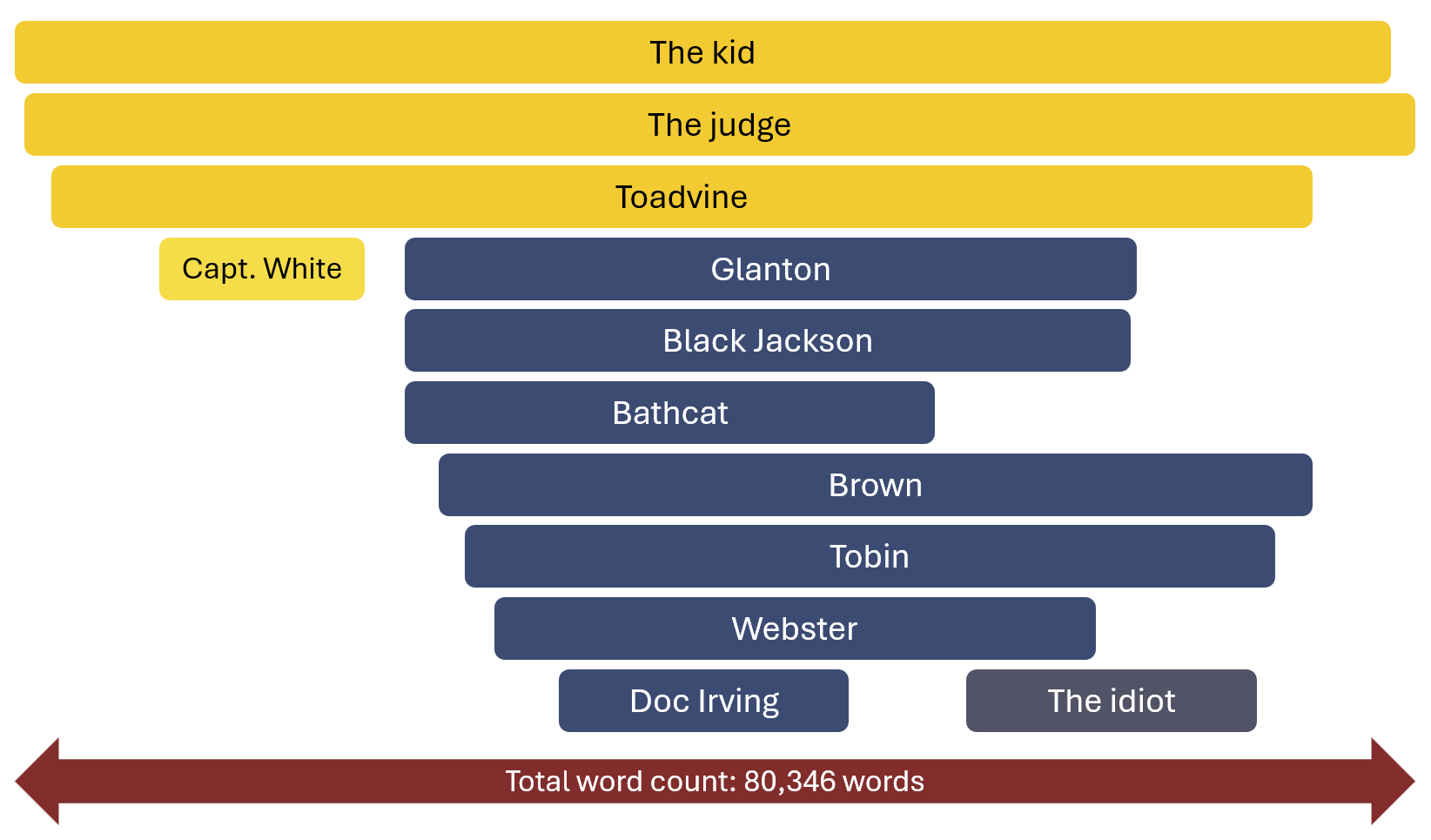
The diagram above is a high level view of the entrance of each key character and the duration of their presence in the story, in terms of word count between the first and last mention of their name. Some characters meet a dramatic and vividly described ending, and for others their fate is left a mystery after the final mention of their name.
The kid, the judge, and Toadvine are the big three characters. The book starts with only the kid and ends with only the judge, and Toadvine is present for nearly all of their time together. The names in blue above are other key members of the Glanton Gang.
Travels with the Glanton Gang
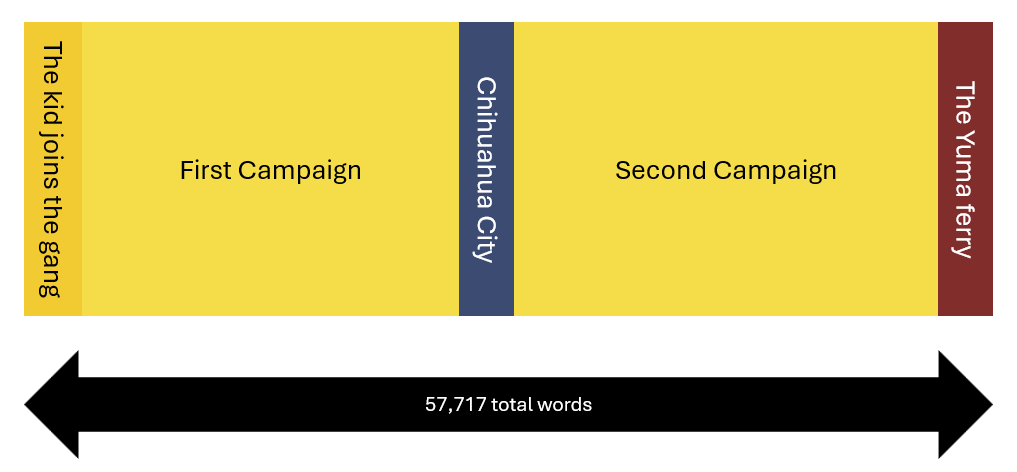
Blood Meridian is often described as the story of the kid's travels with the Glanton Gang. There's actually more than that to the story, but his time with the Glanton Gang is definitely the core of the book, and over 70% of the total word count.
After getting to know the storyline better, I have come to see the kid's time in the Glanton Gang in terms of the structure reflected in the diagram above, with five sections akin to acts in a play:
- Act I: the kid and Toadvine join the gang, and everyone prepares to leave on a scalp-hunting mission down into Mexico.
- Act II: on their first campaign, they are collecting scalps ("receipts") under contract to Angel Trias, the governor of Chihuahua. There are also many details in this campaign that foreshadow things to come: the reading of the Tarot cards, stories told by and about the judge, the kid pulling an arrow from Brown's leg, and more.
- Act III: they enter Chihuahua to a hero's welcome, become wealthy after redeeming their scalps, and then squander that wealth as well as the goodwill of Chihuahua's citizens in a multi-day orgy of drunken debauchery.
- Act IV: the second campaign becomes a gruesome parody of the first at times, and they become the hunted as well as the hunters, driving Glanton to madness.
- Act V: after taking over the ferry crossing of the Colorado River, most of the gang is slaughtered by the Apaches, and the survivors find themselves fleeing across the desert, where the kid and the judge are repeatedly pitted against one another.
An evening in Fort Griffin
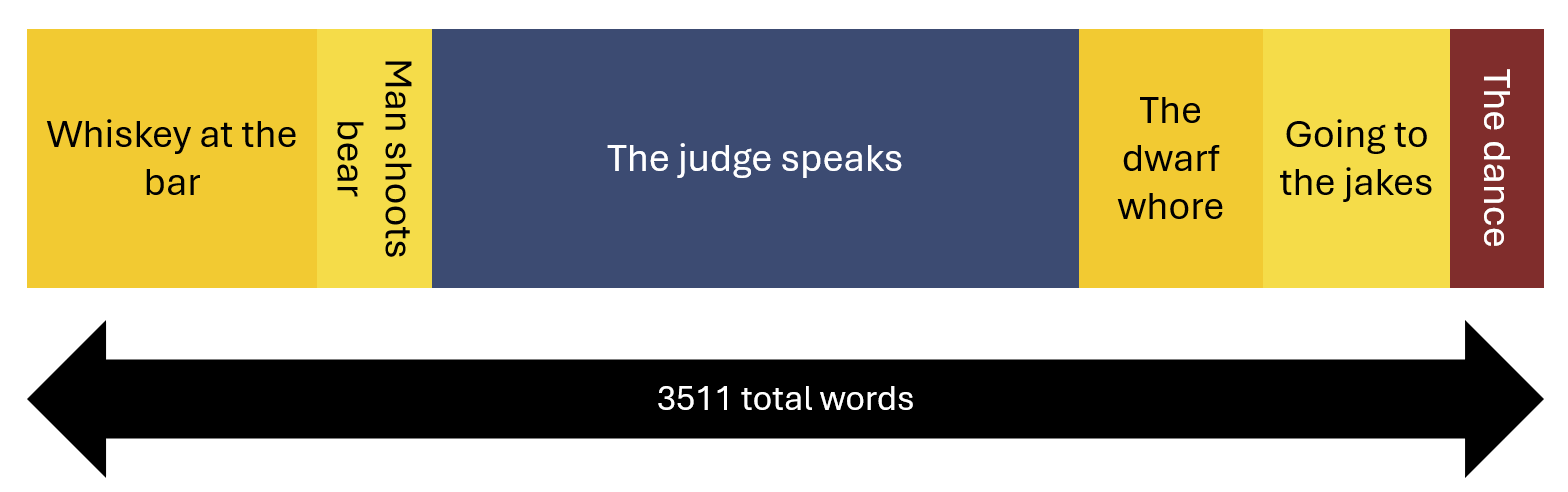
McCarthy spent many years writing Blood Meridian, and I'd say this really shows in the final section covering an evening in the town of Griffin. Nearly every sentence is there for a reason, and rewards repeated reading.
The judge's speech to the kid at the bar, which ties together so much of what has come before, is my favorite part of the entire book. Below are a few quotes that set the tone, without giving away many details.
The judge poured the tumbler full where it stood empty alongside the hat and nudged it forward. Drink up, he said. Drink up. This night thy soul may be required of thee.
This is an orchestration for an event. For a dance in fact. The participants will be apprised of their roles at the proper time. For now it is enough that they have arrived.
Only that man who has offered up himself entire to the blood of war, who has been to the floor of the pit and seen horror in the round and learned at last that it speaks to his inmost heart, only that man can dance.
Audiobook recommendation
I've mentioned both reading and listening to this book. Living in Montana, where we often find ourselves driving great distances, I've become a fan of listening to audiobooks, and I'll end this post with a recommendation: I love actor Richard Poe's narration of Blood Meridian.
One of Cormac McCarthy's writing habits, which some people find off-putting, is that he doesn't use quotation marks during dialog, and often doesn't explicitly clarify who is speaking. In Poe's reading, he uses an identifiable voice for each character, which makes the dialog easier to follow.
Here's a review of Richard Poe's reading of Blood Meridian. Highly recommended.