Kathmandu Butcher Shop
The night air in the butcher shop was thick and dirty, like the coagulating blood smeared red and brown across the counter and crude chopping blocks. Cuts of meat lay behind the counter on wrinkled brown paper stained with puddles of fat and blood. The bare fluorescent tubes buzzing overhead bathed the room in soft blue light, a welcome relief from the darkness of the narrow alleys and streets outside.
My “friend” yelled something in Hindi to a young man behind the counter, and the young man tore off the corner of one of the scraps of brown paper and handed it to him without a word. My friend watched the front door and the dark sidewalk beyond while he tore off a corner of his small plastic envelope of gooey black hashish. He dropped the oozing corner onto the scrap of brown paper and folded it into a tight little package.
I handed him the money while glancing at the bloody surfaces around the store. He handed me the hash, never taking his eyes off the street outside the window, where stern hard-bodied Nepali police officers with blue-handled nightsticks were patrolling the nearby Thamel district. He said “you know where to find me,” and I sarcastically responded “I sure do,” then we both walked quickly away from the store in opposite directions.
The young man standing behind the counter watched us go in silence, bloody hands hanging at his sides.
Mom was tired that night, and she went to bed early after we returned from an evening trip to Swayambunath, the monkey temple overlooking the Kathmandu Valley. I sat for a while on the other bed in our simple room at the Katmandu Guest House, writing in my journal by the light of a flashlight, then decided to take a walk.
My first stop was the small crowded bookstore next door. I bought a copy of “A Million Mutinies Now” by V.S. Naipaul, his award-winning story of modern India. We would be entering India in a few days, and I had been told that this book offered a good overview of the types of cultures and experiences we would find there. I intended to read it during our upcoming days in the jungles of Royal Chitwan National Park, in the lowlying Terai region of Nepal near the Indian border.
Book in hand, I plunged into the dark streets of the Thamel district. During the day, these streets had been crowded with tourists and hustlers of all types. At night, the mood was different. There were fewer tourists, and the local people seemed to be actually going somewhere, rather than hassling tourists for change or trying to sell trinkets. I hadn’t seen many cops during the day, but now there was a cop at every major intersection, and I nodded at some of them but they never smiled or nodded back.
I knew what I was looking for, and expected it to be easy to find. We had passed many of them during the day, while I was with Mom, and I thought there might be even more at night. But quite the opposite: whether it was because of the many police officers or the smaller number of tourists this time of night I didn’t know, but they were nowhere to be found.
After wandering south through the neon-lighted storefronts of Thamel, I headed down a dark street that I thought led to Durbar Square. There were almost no tourists now, one or two on each block. I walked past Nepali, Indian, and Tibetan people on the street, and then suddenly I found what I was looking for, like so many Western visitors in the decades before me: a young Nepali man walked briskly past muttering “opium, hashish, opium, hashish?” I smiled at him, and he stopped.
“How much for hash?” I asked, trying to act casual, like I did this all the time.
“You come to my home, see the quality, you make me offer.”
“No thanks,” I said, “I need to stay on the street.”
“No problem, follow me.”
I did, and he walked around the corner to a taxi parked in front of a dark storefront. He said something to the driver in Hindi, then squeezed into the tiny back seat and motioned for me to follow him.
“No,” I said while leaning in the open door. “If it’s not close enough to walk then I can’t go.”
“Only two minutes, mister, only two minutes away.”
“No thanks,” I said, then closed the car door and turned to walk away.
He jumped out and ran around the taxi to follow me. “I will take you to a restaurant, you drink tea and wait two minutes for me.”
“OK,” I responded, “I can do that.”
He led me down a dark side street, around the corner, then down a street only a few feet wide, narrower than the alleys back in Chicago. Even in the daylight, I had found it hard to have a clear sense of direction and distance in Kathmandu, because many areas of the city have road maps that look more like a plate of spaghetti than the orderly grids of large American cities. The streets of Kathmandu aren’t marked, and to Western eyes they all look about the same: surprisingly narrow, cluttered with people and animals and a variety of vehicles during the daylight hours, and thoroughly confusing. At night, unable to use distant objects like Swayambunath temple to maintain my bearings, I had no clue which direction we were going.
We continued a few blocks into an area with smaller buildings pressed close against one another. It was nearly silent now, nobody on the street and no signs of life from the windows or rooftops. A grey-bearded man in a turban walked past us, then stopped to openly stare at me. I wondered what he was thinking about the bald tourist clutching his V.S. Naipaul paperback, following a nervous young man into the silent darkness.
“How much farther?” I asked after we were out of earshot of the turbaned man.
“Closer now,” he responded without turning around, walking two steps ahead of me.
We continued down narrow streets between dark buildings. There were no streetlights, no moonlight, and the only light came from an occasional flickering candle or dim light bulb in a window. I couldn’t see my feet, or the crumbling pavement of the street.
We passed two young men standing in a doorway, and they looked at me and then smiled at my friend. I couldn’t see his face, but I decided this wasn’t looking like a good idea any more. I was lost, in the middle of the night in a strange city. I wasn’t carrying a lot of cash, but he didn’t know that, and I had a valuable U.S. passport on me. If something happened I wouldn’t be missed until morning, and nobody knew where I was anyway. I decided I shouldn’t take this any farther.
“That’s far enough,” I said at the next intersection. “I can’t go any farther.”
I turned and started walking back the way we came. He ran to catch up with me, and the negotiations started.
“How much you want?”
“Oh, half a gram would be plenty, I’m only here for a short while.”
“I can get you 5 grams for 5000 rupees, 10 grams for 9000 rupees.”
That translated into $75 for 5 grams, which was much more than I wanted to spend, and much more hash than I could smoke in the next two days before leaving Kathmandu on a flight to India. I kept walking, trying to remember the way we had come, while we kept talking.
“No, I don’t have that much. I only have 1000 rupees on me,” I lied.
“You don’t understand Nepali system, mister. Nepali system is five-gram packages.”
“Well, where I come from,” I said in my best sarcastic Chicago accent, “if somebody wants less than that you just sell him what he wants. That’s the system I’m used to.”
He pulled out a small plastic pouch and showed it me. “Five grams here, mister, very good hash, only 5000 rupees.”
I was immediately angry and also a little scared when I saw the package. I thought we had been going to his home because he didn’t have any on him, but now I saw he had the drugs with him all along. Why did he try to get me in a cab? Why did he lead me down these narrow streets to a more deserted part of the city?
“Hey,” I said in a loud and angry tone, “if you had that on you the whole time why were you taking me for a walk? What was that all about?”
He ignored my question and continued pleading for me to buy all five grams. Now we were back to a part of the city where there were more people on the street, and I thought we might be near where we had first met, although I wasn’t sure.
“I only have 1000 rupees,” I said firmly, “you want to sell me 1000 rupees of hash or not? If not, I’ll find somebody who wants my money.”
He looked around, then said “here, follow me” and stepped into a little butcher shop we happened to be walking past, where we did the deal.
I navigated my way back to Kathmandu Guest House by intuition, arriving by a different route than I had left. I saluted the guard at the gate with my right hand, index finger against the middle of my forehead just like he always did, and I breathed a little easier after walking through the candle-lit patio and into the hotel. The guards at Kathmandu Guest House do a great job of keeping everyone except the guests off the property, so I felt very safe and secure there.
Back in our room, I improvised a way to smoke some of the hash. I had a lighter, and I found a toothpick which I dipped into the tar-like substance and swirled around to coat the end with a big glob. I lit it with the lighter in the bathroom and inhaled some of the brown smoke. The smell was vaguely familiar and the smoke expanded in my lungs, both of which seemed like good signs. After repeating this a few times with some bigger hits, I started to feel a good buzz. It wasn’t a light-headed feeling, more of a stupefying buzz than I remembered from the hash of my youth in suburban Seattle, but a decent THC buzz nonetheless.
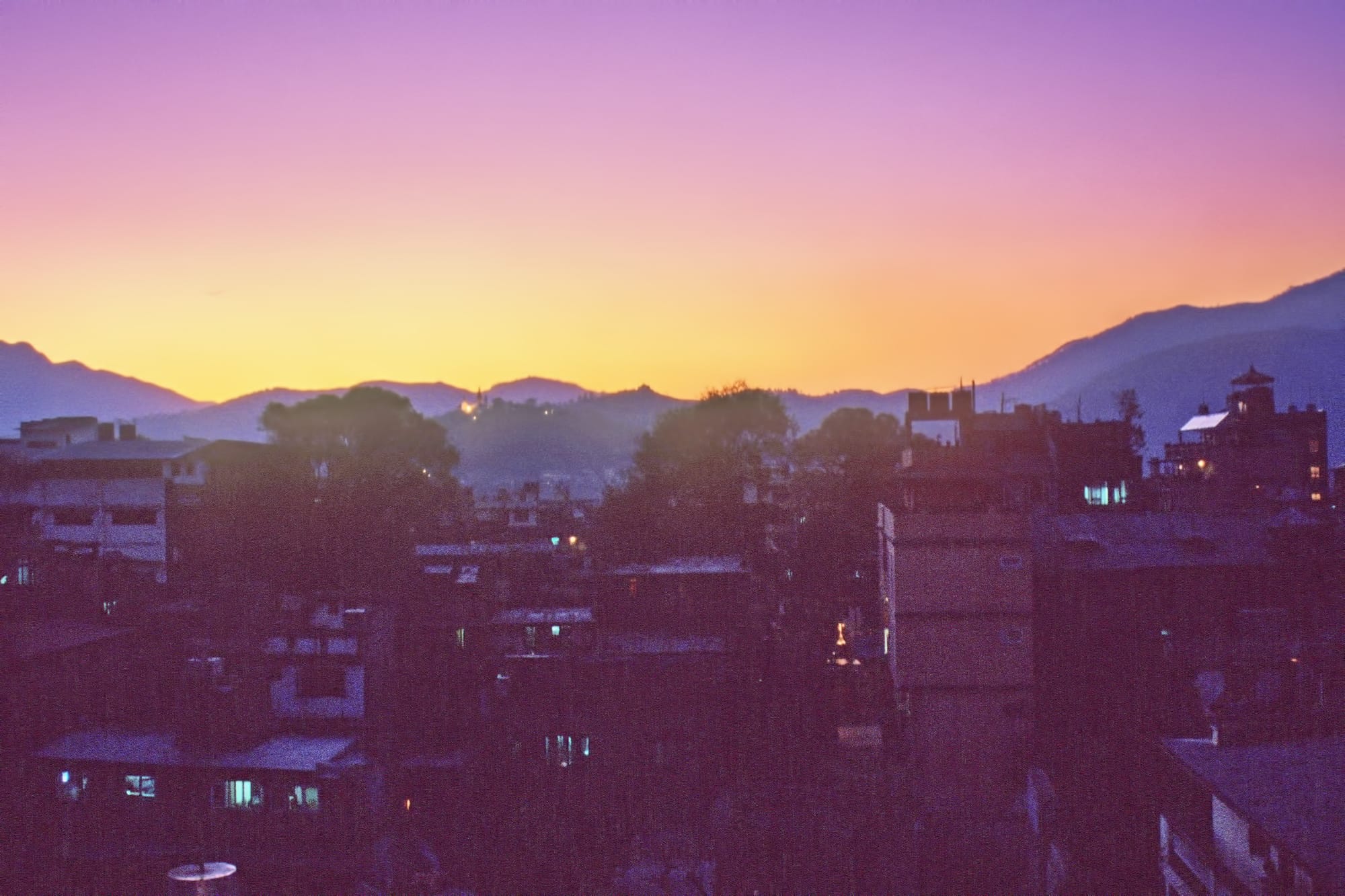
I sat on the bed and read the first chapter of the V.S. Naipaul book, then felt restless and decided to go outside and get some fresh air. I quietly left the room while Mom slept peacefully, and walked up the dark stairway to the roof of the hotel. I had discovered earlier in the day that you could get on the roof this way. Amidst the water tanks and ventilation ducts there were a few plastic chairs and some potted plants. I sat in a chair and stared up at the stars, enjoying the solitude of this deserted place in the midst of the crowded and chaotic city. A cool breeze sprung up, and the smells of Kathmandu seemed more subdued than they had all day.
Soon I felt very tired, and returned to my room. I wrote up my evening’s experience in my travel diary, and after carefully re-living the evening in my mind and writing it down I ended my journal entry with “I’m more scared right now, back in the hotel room, than I ever was while this was going on.” Then I turned off the flashlight and went to bed. It was nearly 1:00am, and the alarm was set for 3:30am because our driver was picking us up at 4:00 to take us up to Nagarkot (elevation 6000 feet) to watch the sun rise over Mount Everest.
At 2:30am, I woke from a dream in which Nepali men were butchering Mia, my beloved Alaskan Malamute back home in Chicago. I couldn’t get back to sleep after that, and lay there listening to dogs barking and a nearby rooster crowing until the alarm went off at 3:30. I don’t know why, but this one rooster always crowed from 2:00 on, every night we were in Kathmandu, and a light sleeper like me notices these sorts of things. That night with the hash was the only night I slept a little longer, until 2:30.
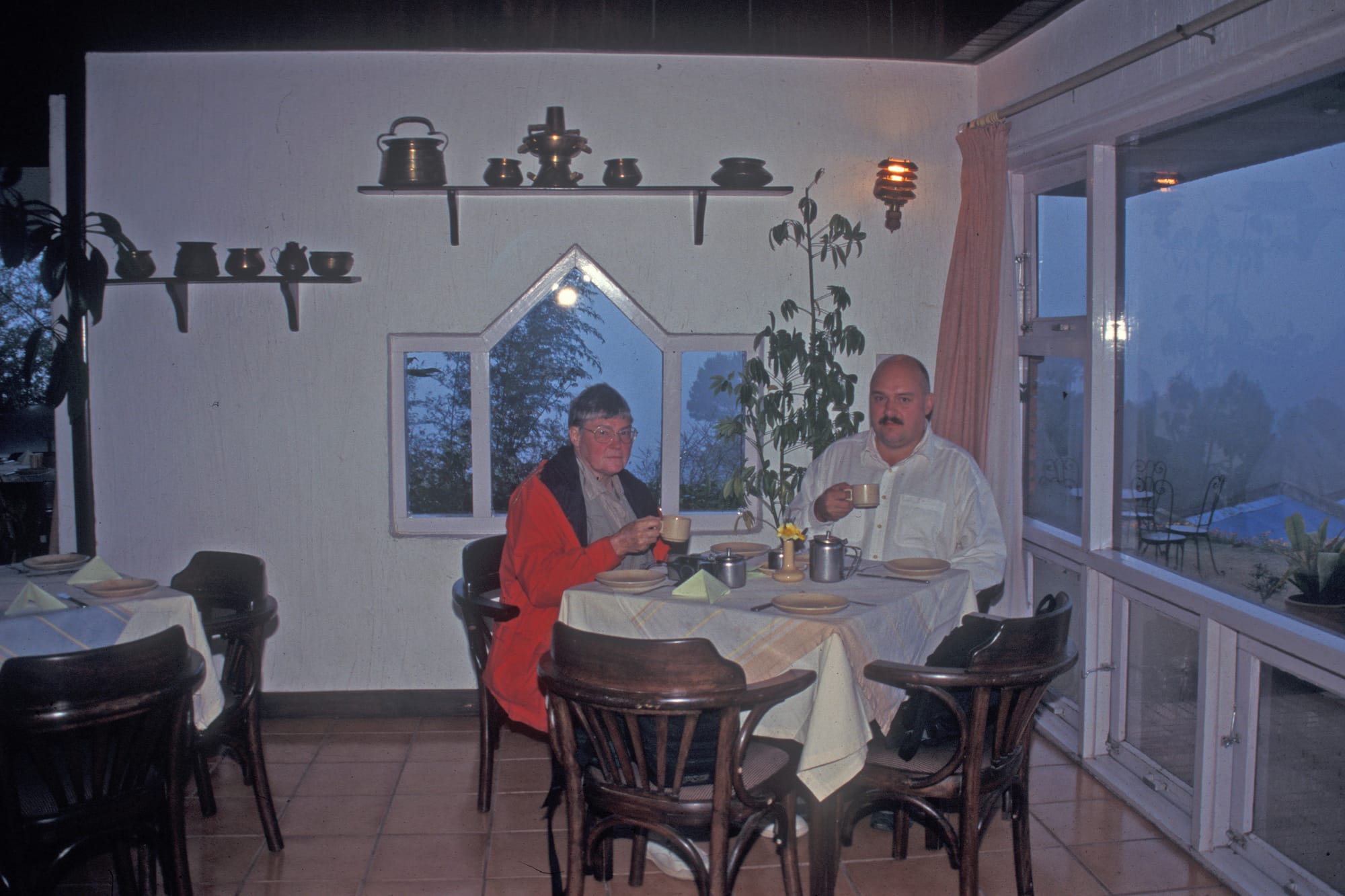
A few hours later, after a terrifying tax ride through the fog up the 7000-foot ridge east of the Kathmandu Valley, I told Mom about my little adventure over a traditional Nepali breakfast of boiled potatoes and mutton. A lot of people don’t share those types of things with their mothers, but I’ve never had many secrets from her. She has always been able to accept that I might want to experience some things she doesn’t approve of, probably because she had the same type of relationship with her own mother.
We returned to a busy day of sightseeing around Kathmandu, and later that night Mom said “you seem more relaxed today," adding "you were such a live wire the last few days in Cambodia and Nepal, trying to soak up everything, but now you seem relaxed.”
“It must be the hash”, I replied, and we both laughed.