Books I've enjoyed lately
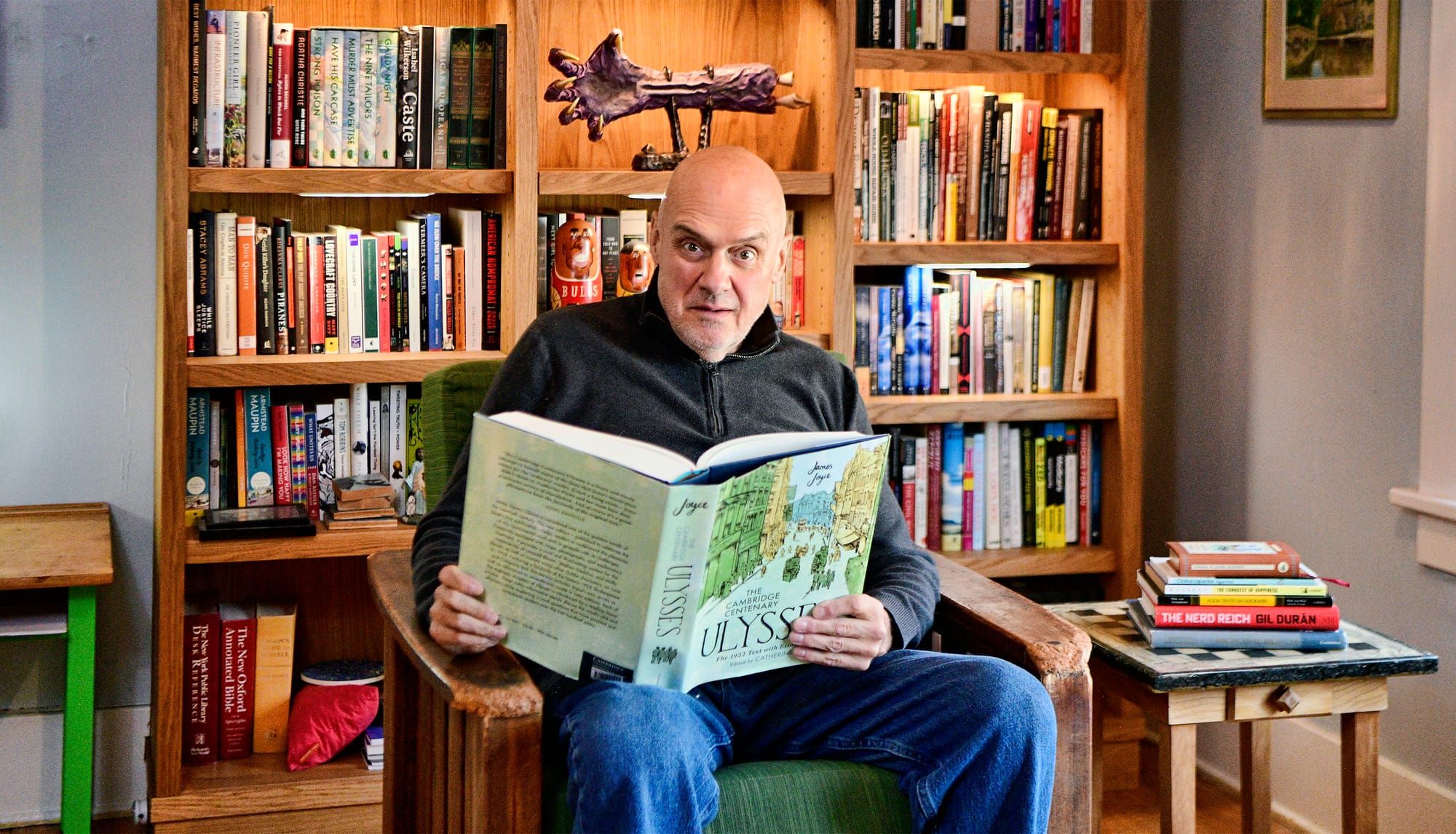
Retirement has been great for reading more books than ever before. And recovering from two knee surgeries last year gave me even more reading time, so I've read a lot of books in the 18 months since I last did a book reviews blog post.
I've had a few individual book review posts in draft form for a while, but I decided to merge them all together into this long post covering various books I've enjoyed. I've also read (or merely started) a few books that just didn't click with me, but they're not included. As Thumper famously said in Bambi, “If you can't say something nice, don't say nothing at all.”
Several of these books are classic novels that I've been meaning to read for most of my life. It feels good to check those off my never-ending and constantly growing “books to read” list. I didn't read much fiction when I was young, so now I can read those old classics as if they were new and fresh. Because they are, to me!
Of Mice and Men
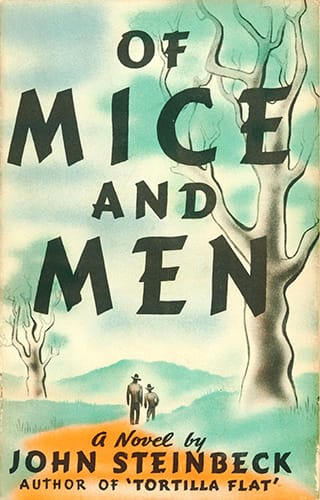 This classic by John Steinbeck surprised me. I had always assumed from the title that it was a philosophical treatise about courage or something like that. Definitely not.
Of Mice and Men is more of a visceral read than an intellectual one, full of unforgettable characters who reminded me of people I've known. The theme of longing for an unattainable life and the heart-wrenching relationship between George and Lennie felt like they could be part of Cormac McCarthy's Border Trilogy, which I've enjoyed reading many times.
“Men have in their minds a picture of how the world will be, and how they will be in that world. The world may be many different ways for them, but there is one world that will never be. And that is the world they dream of.”
– Eduardo the pimp in The Border Trilogy
The Genius Myth: A Curious History of a Dangerous Idea
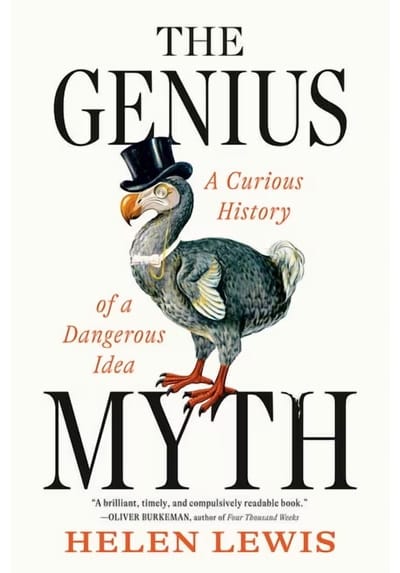 Did you know that the concept of a “genius” is relatively new in human history? To the ancient Greeks and Romans, genius wasn't a type of person, but rather it was something that visited a person, an inspiration that shone through them for a moment or a period of time. Men like Aristotle, Plato, Marcus Aurelius and Seneca the Younger weren't considered geniuses in their time, they were merely touched by genius.
But in the late Middle Ages, the word genius started to be used to describe a certain type of man. (Almost always a man, and almost always a white one.) Leonardo da Vinci, a man of many talents, was one of the first men to be broadly labeled as a genius, and in Helen Lewis's well-researched and often hilarious book The Genius Myth, she makes a compelling case that “you don’t just have to be Leonardo, you also need Florence.”
The point being that we may have never heard of da Vinci if he hadn't the good fortune to be born in Florence, the birthplace of the Renaissance. Similar strokes of luck and timing apply to all so-called geniuses. They are merely talented men who worked hard and got lucky, and not a superior sort of human being.
The Genius Myth explains how applying the word genius to these lucky white men has distorted our understanding of creativity, success, and achievement. We give men in certain occupations – CEO, scientist, artist, entrepreneur – great latitude in their personal behavior, accepting traits that would be abhorrent in others. And we take their often naive views on topics outside their areas of focus seriously, with excuses such as “he's a genius, his brain works differently from mere mortals.”
Genius Myth explores a few of the many so-called geniuses who have done great harm outside their narrow fields of expertise. William Shockley, for example, famous in the 1950s for inventing the transistor, spent the 1960s and 1970s spewing racist eugenicist nonsense. (His actual role in the development of the transistor is also a controversial topic, but I won't get into that here.)
Shockley claimed that “my research leads me inescapably to the opinion that the major cause of the American Negro's intellectual and social deficits is hereditary and racially genetic in origin and, thus, not remediable to a major degree by practical improvements in the environment.” Research? His biographer, Joel Shurkin, noted that Shockley had almost no contact with black people over the entire course of his life, but his views on race were taken seriously and widely published and debated because he was a genius.
Shockley eventually got the reputation he deserved. His Los Angeles Times obituary noted that “he went from being a physicist with impeccable academic credentials to amateur geneticist, becoming a lightning rod whose views sparked campus demonstrations and a cascade of calumny.”
Elon Musk is another figure covered in The Genius Myth, as a current example of a man whose controversial reputation in one or two narrow domains has given him carte blanche to wreak havoc in areas of which he knows little or nothing, such as government efficiency and military planning.
Lewis suggests that the term genius has run its course, and is no longer useful. But useful or not, it's clear that modern Western society still loves the genius myth.
“Simply having a high IQ does not make you an expert on foreign policy, or economics, or any of a thousand other political questions. In many cases, a self-image as a ‘clever person’ simply makes you more likely to hold your incorrect opinions extremely forcefully.”
– Helen Lewis, The Genius Myth
“People who boast about their IQ are losers.”
– Stephen Hawking, IQ 160
Emma
 After reading Pride and Prejudice last year, I decided to check out another Jane Austen classic. I consulted with Megan — the Jane Austen expert in our household — and she recommended Emma. Great choice, I loved it. A tangled web of entertaining characters, several of whom I genuinely missed once the story came to an end.
There are some ways in which the character of Emma reminds me of my mother, but explaining that observation would require more than I want to write here. Perhaps fodder for a future blog post.
“Seldom, very seldom, does complete truth belong to any human disclosure; seldom can it happen that something is not a little disguised, or a little mistaken; but where, as in this case, though the conduct is mistaken, the feelings are not, it may not be very material.”
– Jane Austen, Emma
Ulysses
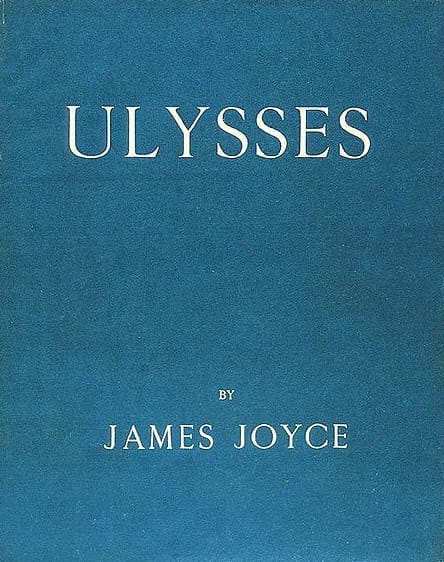 Another classic I've meant to read for a long time, and one of Megan's favorite books. I knew that it was the stream-of-consciousness story of a day in the life of a guy named Leopold Bloom, but other than that I really had no idea what was coming. And a lot was coming! (Not least Leopold himself.)
The experience of reading various scenes set in bars in Ireland took me back to the time Megan and I found ourselves locked inside a bar in Galway, Ireland after closing time. Closing time over there just means nobody else can come in, but if you're already in the bar, you can carry on drinking and listening to the band and eavesdropping on drunk patrons as long as you'd like. Which we did. A great approach that we Americans would do well to emulate in our own bars.
“I’ve put in so many enigmas and puzzles that it will keep the professors busy for centuries arguing over what I meant, and that’s the only way of insuring one’s immortality”
– James Joyce on writing Ulysses
Deep Survival: Who Lives, Who Dies, and Why
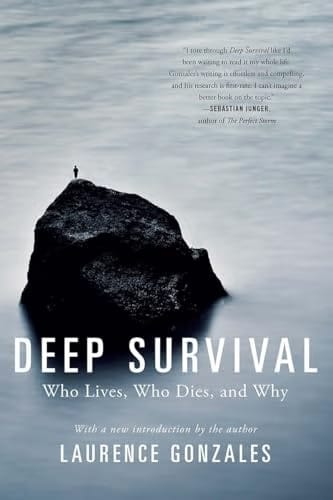 Laurence Gonzales has led an unusual life. An award-winning author, he has also worked as a stunt pilot, toured as a rock musician, narrowly escaped a famous commercial plane crash, and his father was a bomber pilot in WWII who survived a fall from high altitude without a parachute. With a background like that, it's little wonder that he has spent a lifetime discussing survival concepts with test pilots, special forces soldiers, neuroscientists, psychologists, and friends — including Lyle Lovett and Cormac McCarthy, of all people.
Deep Survival: Who Lives, Who Dies, and Why is a comprehensive analysis of documented survival scenarios including shipwrecks, plane crashes, wilderness tragedies, and other calamities. The book weaves together findings from neuroscientific studies and research papers, interviews with survivors, and the author's own life story into a massive psychological thriller punctuated by real-life adventure narratives. When I saw that Sebastian Junger, author of The Perfect Storm, is a fan of the book, I knew I had to read it.
The first half of Deep Survival explores how people get into trouble ― why do otherwise rational people often make dubious decisions that turn a potentially minor inconvenience into a life-threatening situation? The second half digs into why some people survive extreme circumstances and challenges, while others perish in situations that don't appear nearly as dangerous.
The book covers many aspects of these questions, and two major themes arise again and again. The first is that the best survivors aren't rigid thinkers. Rather, they're those with the most flexible minds, people who are able to constantly re-evaluate their options in light of new information. In Gonzales's words, “rigid people are dangerous people.”
The second recurring theme is that survivors tend to be people who believe they are in control of their lives, people who don't feel self-pity and rarely complain. Psychologists refer to such people as having an interior orientation; they always believe that there are things they can do that will make a difference. Persons with an exterior orientation, on the other hand, often feel like helpless victims of external circumstances. The person complaining about the weather on the first day after a shipwreck is unlikely to be one of the survivors, if the situation drags on for a prolonged period of time.
Gonzales interviewed survivors of several scenarios where persons with a wide range of capabilities were unexpectedly thrust into a difficult situation, such as spending weeks or months on a lifeboat in the ocean or lost in the wilderness. It's striking how often the ultimate survivors of those scenarios weren't the strongest or most experienced. As Gonzales points out, “The word 'experienced' often refers to someone who's gotten away with doing the wrong thing more frequently than you have.”
An analysis of persons who had survived being lost alone in the wilderness found that 3-6 year olds are more likely to survive longer than 6-12 year olds. The older kids are more experienced, but the younger kids simply react to what's directly in front of them at each moment. The older kids have started developing the habit of creating a mental model of the world around them, and they may place dangerous trust in a mental model that is flawed. Many times, a person has perished in the wilderness because they were convinced that they knew which direction they needed to travel to reach safety, but their theory was wrong and their faith in it blinded them to new contradictory information.
Deep Survival also covers the psychological tactics of survivors. Why do the most successful people in high-risk occupations tend to constantly joke about the dangers? Why do some people freeze in dangerous situations while others remain calm and focused? Why do some people fall in love with their own ideas and defend them, while others seem to constantly be looking for the flaws in their own thinking? (Spoiler alert: the latter group is more likely to survive a disaster.)
I think one of the reasons I enjoyed this book so much is because I love that feeling of being alone in the wilderness, miles from pavement, electricity, or human beings. It's exhilarating being on your own, making your own decisions with no meddling from others, fully responsible for your own health and safety (and perhaps that of one or more loved ones), and it's deeply satisfying to come home safely with so many great memories. This summer, I've enjoyed those feelings many times, including a night in the Kootenai Wilderness with Nancy, a solo hike in the Highland Mountains, and an outing to a remote wilderness cabin with Isaac. Deep Survival helped me understand why I enjoy those experiences so much, and also taught me a lot about how to be even better prepared for them in the future.
“The maddening thing for someone with a Western scientific turn of mind is that it’s not what’s in your backpack that separates the quick from the dead. It’s not even what’s in your mind. Corny as it sounds, it’s what’s in your heart.”
― Laurence Gonzales, Deep Survival: Who Lives, Who Dies, and Why
A Farewell to Arms
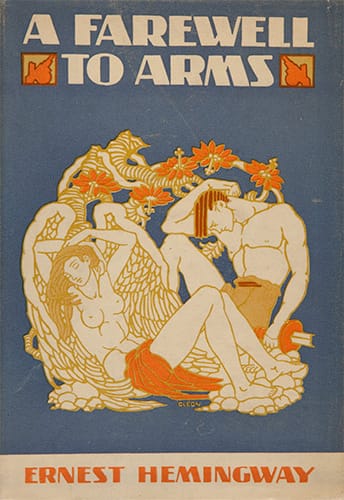 Last September, my friend Tom had a hip replacement. in October, I had infection cleanout surgery for my knee, and spent some time in the hospital. When I got home from the hospital, Tom had a great suggestion: let's read a book together, while we're both having lots of down time with icepacks and elevation to recover from our surgeries. We compared our “to read” lists, and decided to tackle A Farewell To Arms, Ernest Hemingway's first best-seller published in 1929.
Hemingway had served in WWI as a Red Cross ambulance driver in Italy, and A Farewell To Arms is the semi-autobiographical story of a young American soldier in the ambulance corps of the Italian Army. Tom and I would read a few chapters, then swap long rambling emails about our thoughts and reactions, and then move on to subsequent chapters.
It took us about a month to get to the book's ending, which is widely considered the saddest ending of any of Hemingway's novels. Despite it being such a famous work, neither of us knew any details of the plot before reading it, so we experienced the shock of that ending together.
Having enjoyed that shared experience, Tom and I were planning to read another book together. But I wanted to read Moby-Dick next, which Tom wasn't interested in, so we decided to read The Sun Also Rises after I finished Moby-Dick. But before I had finished Moby-Dick, Tom died, suddenly and unexpectedly.
So A Farewell To Arms, a book famous for its brutally sad ending, will for me always be tied to the loss of my friend Tom. I'll probably re-read it some day, just to remember the fun we had discussing each chapter, but it's going to take some time to be ready for that.
“The world breaks everyone and afterward many are strong at the broken places. But those that will not break it kills. It kills the very good and the very gentle and the very brave impartially. If you are none of these you can be sure it will kill you too but there will be no special hurry.”
– Ernest Hemingway, A Farewell to Arms
Moby-Dick
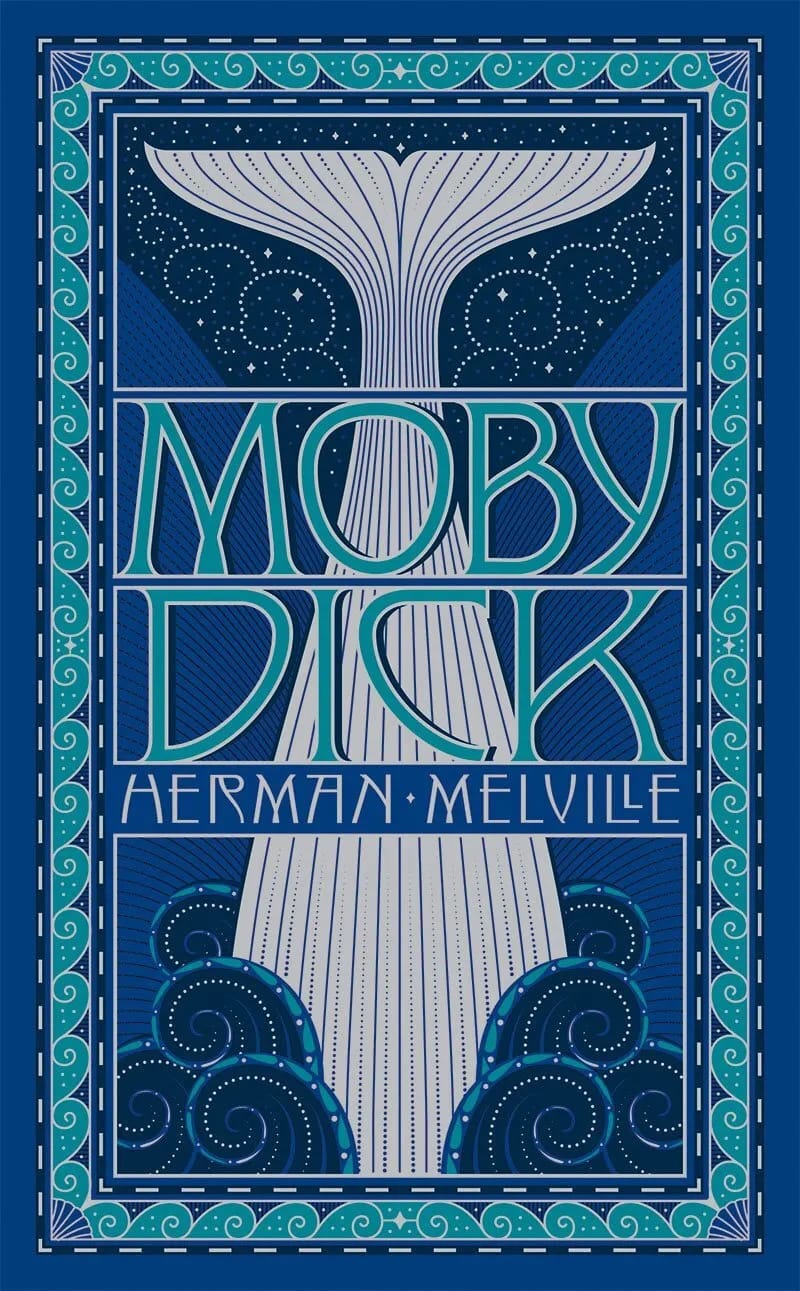 I've meant to read Moby-Dick for a long time, and last winter I finally checked it off the list. I had started it once in the 1970s, but grew bored with the minutiae of whales and whaling and never finished it. I guess my attention span has grown longer since then.
Moby-Dick is a well-known and widely respected book that has been reviewed and critiqued for a long time, so I don't have much to add. Melville's vivid descriptions of expansive seascapes resonate with me, and I also enjoyed his portrayals of simple moments aboard the Pequod. For example, Captain Ahab studying nautical charts while alone in his cabin at night:
The heavy pewter lamp suspended in chains over his head continually rocked with the motion of the ship, and forever threw shifting gleams and shadows of lines upon his wrinkled brow, till it almost seemed that while he himself was marking out lines and courses on the wrinkled charts, some invisible pencil was also tracing lines and courses upon the deeply marked chart of his forehead.
There is much symbolism in Moby-Dick, and most of it goes over my head. After I had read the first few dozen of its 135 chapters, I came across Robin VanGilder's Beige Moth blog, which includes a brief analysis of each chapter of Moby-Dick. I found these analyses very helpful, and I settled into a rhythm where I would read a chapter or two, then check out Robin's posts on those chapters to see what symbolism I had missed, then go back and re-read sections with those details in mind. This really added to my enjoyment of Moby-Dick. Thanks, Robin!
Água Viva
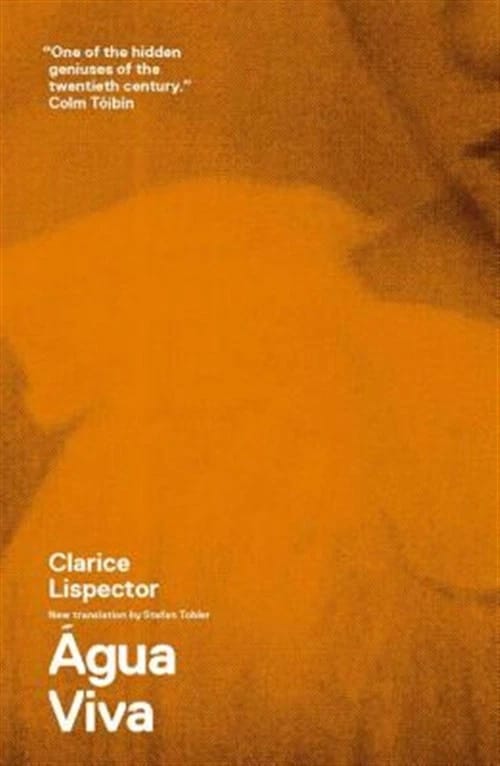 Wow. I don't know what to say about this one. Água Viva may be the weirdest book I've ever read, and I've read some doozies. Is it good? I'm not actually sure, but I found it uniquely unforgettable.
Structured loosely as a rambling letter in the second-person voice, Água Viva is a series of short reflections or meditations from a former painter who has turned to writing, all directed toward an unnamed "you." Sometimes "you" appears to be a former lover or friend, and at other times it feels like Lispector is speaking to her past self as "you."
Although Água Viva is sometimes referred to as a novel, it has no characters and no plot. There are many recurring themes, such as beating hearts, placentas, the writing process, and death. Lispector's writing reminds me of Diamanda Galás's singing – indescribable, shocking at times, and strangely addictive.
I found Água Viva challenging, annoying, confusing, and depressing, but also hard to put down. It definitely isn't for everyone. I saw one reviewer describe it as “bad poetry masquerading as bad prose,” and another summed it up with “If this is what it looks like to escape the prison-house of language, then I am content with a life sentence.”
“This is life seen by life. I may not have meaning but it is the same lack of meaning that the pulsing vein has.”
“What am I doing in writing to you? Trying to photograph perfume.”
– Clarice Lispector, Água Viva
And Then There Were None
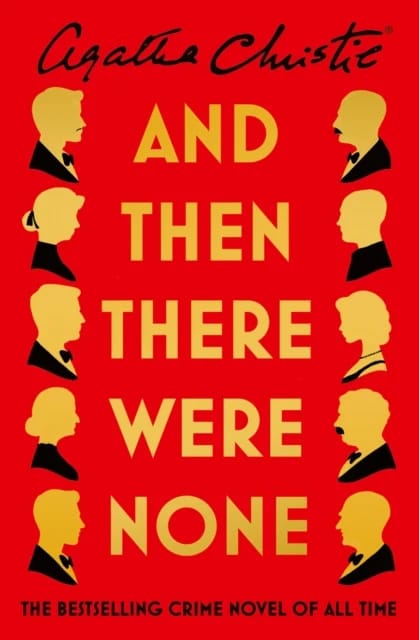 This was my first book by Agatha Christie. Megan, on the other hand, has read all of Agatha Christie's mysteries, most of them multiple times. When I asked her where I should start, she said might as well start with the most popular one, which is also the best-selling murder mystery of all time.
The story is set on an island off the coast of Devon, where ten people are staying at a guest house. Each of these people has some sort of mysterious incident or crime in their past, and one by one each of them dies under mysterious circumstances, leaving – in the final victim's words – "ten dead bodies and an unsolved problem."
Agatha Christie considered this book her finest work, and the story ties together a huge number of little details, hints, and deceptions in a way that remains accessible and interesting despite its dense structure. The ending is truly surprising and baffling, and I immediately re-read it to go back over all the hints I had missed and enjoy how everything fit together so well. It's easy to see how this became one of the best-selling books of all time. A fun and brilliantly written book.
“From now on, it is our task to suspect each and every one amongst us.”
– Agatha Christie, And Then There Were None
The Importance of Being Earnest
 I love Oscar Wilde, and this short book (a play, actually) was a fun read, brilliantly satirizing the upper-class English society of his time.
In reading it, I discovered that it contains several of my favorite Oscar Wilde quotes, such as “I hope you have not been leading a double life, pretending to be wicked and being good all the time.”
“All women become like their mothers. That is their tragedy. No man does, and that is his.”
– Oscar Wilde, The Importance of Being Earnest
The Apology of Socrates
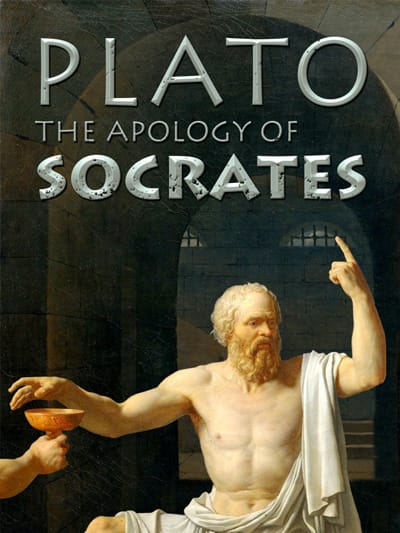 I've been reading various philosophy books since I retired (having never read a single one before then), and after seeing in them several references to Plato's Apology of Socrates, I decided to read it. As a very old text (written in 399 BC), it's in the public domain, and you can find free copies online in many places. For example, here's the copy published by Harvard's Center for Hellenic Studies.
In 399 BC, Socrates was accused of corrupting the minds of the youth of Athens, essentially because he had been teaching young men to think for themselves. He was also accused of asebeia, or worshipping false gods and failing to worship the gods of Athens. These were very serious charges, and he was put on trial and given the opportunity to make a speech defending himself. The Apology of Socrates is that speech, as transcribed by his student Plato, who was in attendance at the trial.
After his speech, Socrates was found guilty by a majority vote of a jury of hundreds of male Athenian citizens, and was sentenced to death by drinking a cup of hemlock. He could have requested permission to flee to Athens and live in exile, but he didn't. His friends visited him in prison and offered him an opportunity to escape, but he declined. He was defiant to the end, proud of what he had been doing in teaching young Athenians to think independently and reach their own conclusions about the world around them. (Note that the word apology in the title of this text is from the Greek apologia, meaning a "defense" rather than an expression of regret. He apologized for nothing.)
The most famous quote from The Apology of Socrates is "The unexamined life is not worth living." Spoken near the end of his trial, this was Socrates' way of refusing to give up philosophy to save his own life. He felt that a human life without critical thinking, self-reflection, and the pursuit of virtue has no true value, and he stayed true to those ideals all the way through his drinking of the hemlock death penalty.
“To fear death, gentlemen, is no other than to think oneself wise when one is not, to think one knows what one does not know. No one knows whether death may not be the greatest of all blessings for a man, yet men fear it as if they knew that it is the greatest of evils.”
– Socrates, speaking at his trial before being sentenced to death
Computer Power and Human Reason: From Judgment to Calculation
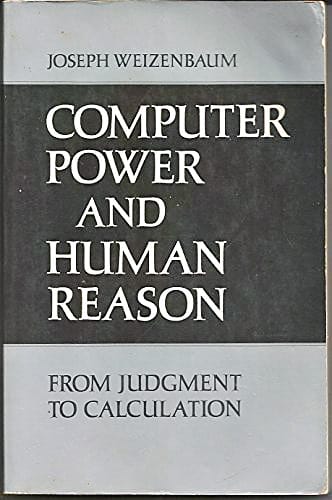 This is a book that I read in the 1970s (my Dad had a copy). Recent news and debates about how people are using LLMs like ChatGPT, Grok, and Gemini motivated me to read it again, and I'm glad I did. I had a vague recollection that the author, Joseph Weizenbaum, had raised some issues that are relevant to current concerns around AI, and after re-reading the book, I feel like Weizenbaum was even more prescient than I remembered.
Joseph Weizenbaum was famous for creating a natural language processing program called ELIZA while he was a computer science professor at MIT in the 1960s. ELIZA was a simple text-based program that mimicked the role of a psychotherapist, and he created it as a demonstration of how easy it is to fool people into thinking that a computer program is an intelligent conscious being. ELIZA would spit out simple stock phrases to start a conversation (for example, "please tell me what's bothering you"), and then it would reply to the user's comments with generic phrases such as "why do you feel that way" or "interesting, tell me more."
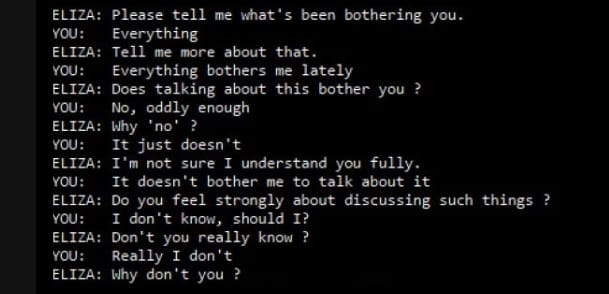
Weizenbaum was shocked by how easily people anthropomorphized his creation, attributing powers to ELIZA that he knew – as its creator – that it simply didn't have. Students would pour their heart out to ELIZA as if it were a "friend" motivated by genuine empathy and concern for their well-being, and they came to believe that they had a "relationship" with ELIZA, just as so many people today have become convinced they have a relationship with their favorite LLM.
Weizenbaum went on to become a leading voice in computer ethics throughout the 1960s and 1970s, and was an early critic of AI while also voicing broader concerns about the impact of computers on society in general. As he states in the opening paragraph of Computer Power and Human Reason: From Judgment to Calculation, published in 1976, “A major point of this book is precisely that we, all of us, have made the world too much into a computer, and that this remaking of the world in the image of the computer started long before there were electronic computers.”
He went on to frame this issue in a way that is as relevant 50 years later as it was then: “A full-scale debate about the computer is developing. The contestants on one side are those who, briefly stated, believe computers can, should, and will do everything, and on the other side those who, like myself, believe there are limits to what computers ought to be put to do ... there is a difference between man and machine ... and there are certain tasks which computers ought not to be made to do, independent of whether computers can be made to do them.”
It's a dense book, full of insights that can take some time to digest, and it's not possible to address more than a tiny portion of it in a blog post. But one thing worth noting is the way Weizenbaum exhibited a humility and self-awareness that is sadly missing from modern technologists.
It's common today for tech executives to casually claim that they are capable of reinventing entire industries, or solving social problems that have stumped the world's greatest minds for ages. Weizenbaum, however, despite being a famous computer scientist and award-winning professor at MIT, Stanford, and Harvard, states in Computer Power and Human Reason “I am professionally trained only in computer science, which is to say (in all seriousness) that I am extremely poorly educated.” In this attitude, Weizenbaum is much like Socrates, who famously said “The only true wisdom is in knowing that you know nothing.”
In hindsight, this book had a big impact on me as a young man heading into a career in software development. I'm glad I re-read it this year.
I've had my father's copy of Computer Power and Human Reason for many years. It was one of the first books I took from his collection at Mom's house after he passed away in 1995. But when I decided to re-read it this spring, I couldn't find it. I think I may have loaned it to somebody, but I don't remember.
So I got online to buy another copy, and was surprised to learn that the book is out of print, and used copies are selling for hundreds of dollars! Eventually I found a beat-up copy for $90. The current price of Computer Power and Human Reason seems confirmation that I'm not the only person who finds Joseph Weizenbaum's perspective still valuable today!
“To understand something sufficiently well to be able to program it for au computer does not mean to understand it to its ultimate depth. There can be no such ultimate understanding in practical affairs.
Programming is rather a test of understanding. In this respect it is like writing; often when we think we understand something and attempt to write about it, our very act of composition reveals our lack of understanding even to ourselves. Our pen writes the word 'because' and suddenly stops. We thought we understood the 'why' of something, but discover that we don't. We begin a sentence with 'obviously,' and then see that what we meant to write is not obvious at all. Sometimes we connect two clauses with the word 'therefore,' only to then see that our chain of reasoning is defective.
Programming is like that. It is, after all, writing, too.”
― Joseph Weizenbaum, Computer Power and Human Reason
The Nerd Reich: Silicon Valley Fascism and the War on Democracy
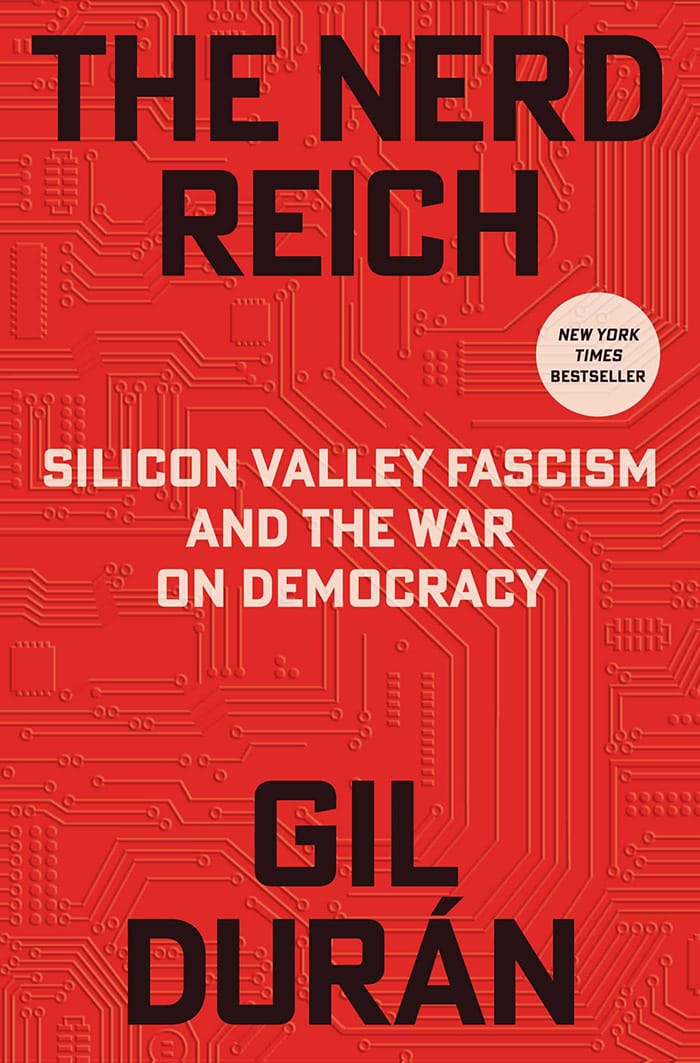 I'm a longtime follower of Gil Durán on social media, and have been eagerly anticipating the publication of his book The Nerd Reich ever since he started writing about the project a couple of years ago. I downloaded the audiobook version in the day it came out (August 18), and had already listened to all of it by the time my hardcover version arrived two days later.
The Nerd Reich explores the rise of technofascism in the United States and the history of the antidemocratic ideologies espoused by tech billionaires Peter Thiel, Marc Andreessen, Balaji Srinivasan, and Elon Musk. Durán traces this ideology from its philosophical roots in the 1997 book The Sovereign Individual by James Dale Davidson and Lord William Rees-Mogg, through recent speeches by Peter Thiel and others espousing themes such as transitioning from nation states to network states and the rise of cybercurrency. In a nutshell, the philosophy of Thiel and other tech billionaires is rooted in the notion that democratically elected governments don't work very well, and network states led by tech billionaires in a "benevolent dictator" model would be much better. For the tech billionaires, maybe!
The Nerd Reich builds on the themes of two other books mentioned above. In The Genius Myth, Helen Lewis warns of the societal ramifications of labeling lucky men as "geniuses"; in Computer Power and Human Reason, Joseph Weizenbaum warned of the intoxicating allure of automation; and in The Nerd Reich, Gil Durán has documented how those two dangerous trends have come together to threaten the foundation of our Democratic form of government.
Durán's book is an important wakeup call for what's happening in the United States. As tech billionaires buy up all major media companies (a process that is now essentially complete with the Paramount/Warner Brothers merger), and unprecedented levels of corporate funding goes to political candidates, the trends Durán has identified will likely accelerate.
“What began as libertarian-inflected fantasy among wealthy entrepreneurs and thinkers in the twentieth century has now curdled into something even more sinister: tech fascism. Tech billionaires partnering enthusiastically with authoritarian regimes.”
― Gil Duran, The Nerd Reich
The Conquest of Happiness
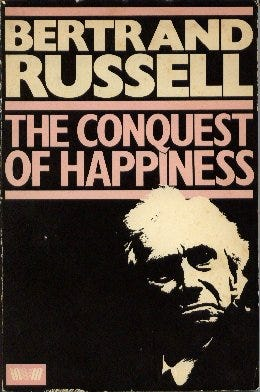 As a math geek, I was interested in the British mathematician and logician Bertrand Russell from an early age. His publication of Russell's paradox in 1901, like Kurt Gödel's publication of his incompleteness theorems in 1931, raised fundamental question about the logical integrity of modern mathematics, and I found that combination of mathematical rigor and unanswerable questions fascinating.
For those unfamiliar, or uninterested in mathematics, I would compare those groundbreaking theorems by Russell and Gödel to Apple Computer's famous 1984 Super Bowl ad, in which a colorful young female athlete hurls a sledgehammer through a massive television screen on which an Orwellian figure is giving a creepy totalitarian speech to rows of soulless men uniformly attired in black and white. To the world of modern mathematics, Russell's paradox and Gödel's incompleteness theorems were as shocking and iconoclastic as that sledgehammer. As a teenager who both loved math and got in more disciplinary trouble at school than most kids, I found men like Russell and Gödel downright heroic.
Russell wrote many books, on a variety of topics, and The Conquest of Happiness is my first experience of his writing on anything other than mathematics. I'm including it it here because I enjoyed it, although I wouldn't necessarily recommend it. Published in 1929, it is at times dated, sexist, or racist, like nearly all books by educated white men of the 19th and early 20th century, but I so enjoy Russell's trademark irreverent wit and relentless logic that I was able to look beyond those details and have a few laughs while reading it.
Russell saw happiness as both a moral imperative and a personal choice, independent of life circumstances. In this, he was following in the footsteps of the great stoics such as Marcus Aurelius and Epictetus.
“I think that in general, apart from expert opinion, there is too much respect paid to the opinions of others, both in great matters and in small ones. One should, as a rule, respect public opinion insofar as is necessary to avoid starvation and to keep out of prison, but anything that goes beyond this is voluntary submission to an unnecessary tyranny, and is likely to interfere with happiness in all kinds of ways.”
– Bertrand Russell, The Conquest of Happiness